
Inspired by a project undertaken by my friend Ghizlane, I have been reading the Constitution of this country. For those who are interested in the summary, I have included the cliffnotes version: my notes are in the post to follow.
I was surprised by how much the wording of the establishment and checks and balances of the branches resembles that of the American constitution, and I thus focused my attentions more on the part played by the King in the constitution. The wording surrounding the King's sections are interesting, leaving the judgement and absolute power to the person himself instead of the written document.
Instead of defining "offensive statement" in the constitution, it seems to be implied that nothing that is offensive to the King is to be allowed, leaving it up to the King to determine what is offensive. It is an interestingly different approach to make the rules personal, according to the relationship and demeanor of each person, and of the king himself, instead of according to absolutes. Like everything else here, it is more personal.
Really the first 4 chapters seem to be the most important, but I've included a few notes about each of the others. Keep in mind, these are just my notes, typed for myself, so I certainly have not captured the entirety of the law here. (This is my disclaimer. If you think I've missed something important, please feel free to comment.)
Monday, April 19, 2010

WARNING: Dry Political Information
Moroccan constitution:
Chapter 1
a constitutional monarchy, in which "Sovereignty will be that of the people who exercise it directly" but the politiacal parties (there are 9 leftist parties, 4 rightist parties, and 7 central parties) will be
representative of the people, and all Moroccan citizens will be held equal under the eyes of the state. It is an Islamic state, but
citizens will be permitted freedom of worship, and citizens are also entitled to freedom of opinion, and "its expression in all forms." Moroccans
are also entitled to free movement and settlement throughout the state. Men and women are guaranteed equal political, educational, and employmental freedom.
The home is "inviolable" and "secrecy of personal contact shall be preserved."
Chapter 2 - monarchy
The Moroccan Crown and the constitutional rights thereof shall be heriditary and
handed down, from father to son, to descendants in direct male line and by order of
primogeniture among the offspring of His Majesty King Hassan II, unless the King should,
during his lifetime, designate a successor among his sons apart from the eldest one. In case of
failing descendants in direct male line, the right of succession to the Throne shall, under the
same conditions, be invested in the closest male in the collateral consanguinity.
King is a minor until he turns 16; a regency council of other governmental leaders has some of his powers,
and continues to advise him until he turns 20.
"The person of the King will be sacred and inviolable."
King can declare the country in a state of emergency, and thus take over on ALL ruling decisions, including dissolving
one or both branches of parliament.
Chapter 3 - parliament
Two houses: House of Representatives, and House of Councillors
House of Representatives - elected by direct universal suffrage for a 6 year term, during October 5 years after previous election.
House of Councillors - elected by an electoral college. 3/5 by region, 2/5 by a nationally elected electoral college. 9 year term, 1/3 of Councillors
replaced every three years, elections held in October
Parliament members are protected from prosecution due to the opinions they express, unless they are detrimental to Islam or the respect owed to the King.
Parliament meets twice a year: On the second Friday in October, and second friday in April. Meetings last less than 3 months.
It's their job to deal with most of the little legal matters that haven't been solved at the police station, but aren't big enough to take to the king
They also have the power to propose new laws, which must make it past the king (and absolute majority of each of both Houses)
Chapter 4 - the government
Govenment composed of prime minister and other ministers, and must answer to both houses and the king. They also ensure execution of laws, and
may propose new bills. Prime Minister is chosen by king.
Chapter 5 - relations among branches
Each house can vote bills down.
Chapter 6 - the Constitutional Council
Composed of 6 people chosen by the king who serve for 9 years, 3 chosen by President of the House of Representatives, and 3 chosen by the Preseident
of the House of Councillors.
The King chooses the chairman.
They deal with all the organic laws, including approving bills to be voted on to become laws, and decisions regarding the maintenence of current laws.
Chapter 7 - the Judiciary
Separate from legislative and executive branches, but all sentences shall be passed and executed in the King's name.
The 10 Magistrates are appointed by royal decree, are irremovable, and are presided over by the king.
Chapter 8 - the High Court of Justice
Government members are responsible for their actions, including felonies, commited while in service.
Chapter 9 - There is an economic and \Social Council.
Chapter 10 - the Audit Court
Supervises legality of the budget. Reports directly to the King.
Chapter 11 - Local Government
Broken down into Regions, Prefectures, Provinces, and Communes. Local assemblies shall be elected. Governors shall be elected. They are responsible
for law enforcement and implementation, and local management.
Chapter 12 - Revising the Constitution requires particular combos of proposals and approval, a bit from each branch
Chapter 13 - Special Provisions
There were only two articles here, clearly add-ons that the original authors thought should be obvious. When parliament members are lame duck, they
still have to do the work, and the past Constitutional Council rulings do not give the current constitutional council the right to do anything
not in accord ith this Constitution.
Wednesday, April 14, 2010
A Moroccan Sunday
America's weekly routine is all about independence and being OUT: Friday nights, or Saturday nights, are for going to parties, dances, or restaurants. Young singles go out on dates these nights, married couples make special time for each other, groups of girls have a Friday night trip to the movie theatre, and groups of guys go to a bar to watch whatever sports game we girls forgot was on. Even families go out to concerts in the park, or go into town for ice cream, or take the kids for a walk on Friday or Saturday evening.
In Morocco,the weekly routines are about the family being IN.
Friday is a day of cooking, and Sunday a day of cleaning.
On Sunday, Amina and her family came to meet me at my house. I'm sure they shake their heads at me when they come over, thinking "this poor little American girl has no idea how to care for a Moroccan house," and it's very true. The methods of cleaning here are quite different. I've been using the squeegee brush instead of a broom or vacuum, but I was not prepared for what happened Sunday. The whole family met me at my apartment in lovely djellabahs and head scarves, which they took off as soon as they were in the door, a storm of velvets and silks that left in its wake all manner of djellaba underclothes: mismatched pajamas, sweatsuits, and the fantastic Moroccan leggings that are made of sweater-fabric.
Amina and her family took the house by storm.
Khadija began rifling through my cupboards and mixing flour with yeast to make the khubz-bread, while Amina and I found all the supplies we'd need, including buying some extra brushes and another bucket (Driss promptly broke the first one). Fuzia and Fatiha began moving the furniture, then filled a giant bucket with soapy water and upended it over my carpet! Driss kept filling the bucket and dumping more water on the floor, and we women rotated through the bristly scrubbing of the carpet, throwing water on the windows and walls, and manning the squeegee to ensure that the flood of water that covered our ankles was shepherded into the squatty-potty drain.
In the flurry of activity and sudsy buckets, everyone and everyTHING was drenched. I want to compare the efficiency of the women rotating scrubbing tasks to a machine, with each part working together seamlessly; however, the efficiency of Amina's family far surpassed any machines that I have seen in the last year. I find it very refreshing after frustrations with Moroccan things not working to be witness to Moroccan PEOPLE working with more expertise than I could imagine. Cleaning the house was like a spectacularly choreographed Renaissance dance.
After everything was soaked, scrubbed, soaked again, and squeegied, we rolled up the carpets and carried them to the roof to dry in the sun. Amina and I went out for a 2-kilo chicken and some olives and lemon to make tagine. I still haven't figured out if the "2 kilos" of the chicken refers to before or after it is killed, but I've found a chicken-man who skins and guts it before giving it to me. I appreciate this a lot.
We sat down as a family to delicious tagine and homemade bread in the apartment that was spotless, but destroyed. We had to sit on the buckets and a few plastic deck chairs, since the couches had been taken apart to wash the cushions. The wool had been removed from the pillows so we could wash the cases, leaving a pile of about a dozen sheep-skins worth of wool in one corner of the apartment. I resisted jumping into this pile for about 2 hours, and was proud of my restraint. When I finally pretended to trip and fall into the pile, the wool engulfed my body completely, and Amina and her family thought it was the silliest thing they'd ever seen.
Despite the open windows and warm sunshine, the apartment was wet for the rest of the day.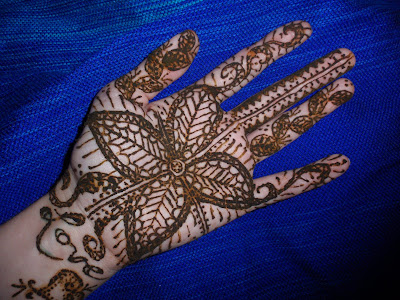
We spent the rest of the afternoon as comfortably as a family. I brought some little gifts to show my appreciation to them for teaching me to clean, and we all made henna and played cards until Amina and her family had to leave to catch the last bus home. They left me with the greatest left-overs, a new determination regarding my apartment, my favorite henna designs, and a refreshed spirit.
In Morocco,the weekly routines are about the family being IN.
Friday is a day of cooking, and Sunday a day of cleaning.
On Sunday, Amina and her family came to meet me at my house. I'm sure they shake their heads at me when they come over, thinking "this poor little American girl has no idea how to care for a Moroccan house," and it's very true. The methods of cleaning here are quite different. I've been using the squeegee brush instead of a broom or vacuum, but I was not prepared for what happened Sunday. The whole family met me at my apartment in lovely djellabahs and head scarves, which they took off as soon as they were in the door, a storm of velvets and silks that left in its wake all manner of djellaba underclothes: mismatched pajamas, sweatsuits, and the fantastic Moroccan leggings that are made of sweater-fabric.
Amina and her family took the house by storm.
Khadija began rifling through my cupboards and mixing flour with yeast to make the khubz-bread, while Amina and I found all the supplies we'd need, including buying some extra brushes and another bucket (Driss promptly broke the first one). Fuzia and Fatiha began moving the furniture, then filled a giant bucket with soapy water and upended it over my carpet! Driss kept filling the bucket and dumping more water on the floor, and we women rotated through the bristly scrubbing of the carpet, throwing water on the windows and walls, and manning the squeegee to ensure that the flood of water that covered our ankles was shepherded into the squatty-potty drain.
In the flurry of activity and sudsy buckets, everyone and everyTHING was drenched. I want to compare the efficiency of the women rotating scrubbing tasks to a machine, with each part working together seamlessly; however, the efficiency of Amina's family far surpassed any machines that I have seen in the last year. I find it very refreshing after frustrations with Moroccan things not working to be witness to Moroccan PEOPLE working with more expertise than I could imagine. Cleaning the house was like a spectacularly choreographed Renaissance dance.
After everything was soaked, scrubbed, soaked again, and squeegied, we rolled up the carpets and carried them to the roof to dry in the sun. Amina and I went out for a 2-kilo chicken and some olives and lemon to make tagine. I still haven't figured out if the "2 kilos" of the chicken refers to before or after it is killed, but I've found a chicken-man who skins and guts it before giving it to me. I appreciate this a lot.
We sat down as a family to delicious tagine and homemade bread in the apartment that was spotless, but destroyed. We had to sit on the buckets and a few plastic deck chairs, since the couches had been taken apart to wash the cushions. The wool had been removed from the pillows so we could wash the cases, leaving a pile of about a dozen sheep-skins worth of wool in one corner of the apartment. I resisted jumping into this pile for about 2 hours, and was proud of my restraint. When I finally pretended to trip and fall into the pile, the wool engulfed my body completely, and Amina and her family thought it was the silliest thing they'd ever seen.
Despite the open windows and warm sunshine, the apartment was wet for the rest of the day.

We spent the rest of the afternoon as comfortably as a family. I brought some little gifts to show my appreciation to them for teaching me to clean, and we all made henna and played cards until Amina and her family had to leave to catch the last bus home. They left me with the greatest left-overs, a new determination regarding my apartment, my favorite henna designs, and a refreshed spirit.
Monday, April 12, 2010
Chocolate, postcards, and internet
1 Happiness is chocolate, postcards, and internet.
2 Happiness is anytime the indoor temperature falls between 40 and 100 degrees Fahrenheit.
3 A note passed from a student to me. During class. That only says "love u."
4 A "roommate meeting"
5 Not needing to worry about matching my clothes in the morning
6 A shower
7 Happiness is the sunshine, that feels ten times more intense, and makes everything glow like magic.
8 Happiness is leaving my house in search of bananas only to have a man pulling a cart of bananas cross my path ON my doorstep.
9 Listening to my neighborhood kids playing soccer in my street at 1am.
10 Using a western toilet.
11 Happiness is being able to give my best friend IT classes, and living in culture where she is not afraid to accept such a gift; in fact, it only feels appropriate after all that she and her family have done for me.
12 Happiness is henna hands.
13 Passing the same set of little markets every time you walk a street, with the same people working them all the time. And knowing when somebody feels lazy, because their store is closed.
14 A donkey. Carrying... anything.
15 Happiness is expressing the same sentiment in several different languages, however poorly; it really makes the moment several times more poignant.
16 Hosting elaborately ceremonial dinner parties
17 Public transportation
18 Being able to type again after having just cut fingernails for the first time in several weeks. ^.^
19 Modern dance with 9 Moroccan girls between the ages of 12 and 18, in the open-air cafeteria patio on the roof of my school.
20 Happiness is the excitement of being out in a familiar and exotic medina all evening and returning home to left-over tagine, my mom's prayer shawl, and the smell of spices still clinging to my clothes.
Thursday, April 1, 2010
Conservation of 'Stuff'
The ultimate show of "my teacher is pleased with us" is to let the students have 'free time.' Don't let the misnomer fool you; 'free time' actually means 'playing soccer,' and free time requests were pretty frequent even in the dead of winter. Today, students in every class immediately began the mantra, "Miss, isn't it sooo nice outside!" The request is regular enough that it doesn't even need to be stated any more. In illustration of the amazing days here, 3aisa was heard to respond, "Don't tell me it's nice outside! It's not winter any more, it's ALWAYS nice outside!"
I recall an American Indian fable about beavers who were gambling; they bid their own soft pelts, because, once given away, they could simply flop their tails in their pure lakewater and grow new ones. Even as a kid, this bothered me because of the clear lack of concern for the conservation of stuff-ness. Stuff can become other stuff, but it can't appear out of no where (I hear adults actually call this Conservation of Matter or something), but spring in Morocco also seems to disregard this Conservation of Stuff.
The once bare streets of dingy cobblestones and dirty gutters now teem with bright silk-clad women and noisy soccer-ball-toting children. Every curb is lined with Moroccans stopping to 'save time' by pausing in the midst of all varieties of errands. Pairs of women sit with groceries, on their way to make cous-cous at home. Children sit with pilfered bottles of water or some small found treasure; they huddle together in secrecy over piles of torn up cookie labels, smacking the pile and claiming any that flip. Men sit and watch the world, on hiatus between watching the world from this cafe and watching the world at the next restaurant. Every space on every curb is full.
In the middle of the sidewalk on the big boulevard is a cross-hatching of grates that occasionally spouts water in a 10x10 set of fountains. I keep waiting for it to surprise an unsuspecting passer-by, but I have yet to be rewarded. The fountain turned on yesterday and seemed to spawn children the way the lake-waters may have spawned beaver-pelts. Children ran underfoot, and other smaller children ran under their feet. Older teens sometimes braved the bustle to have their pictures taken with the fountain; in particular I saw one girl, we'll call her Khadija, in a red velvet djellaba, tiptoe between the fountains and turn to smile at her friend with the camera. At just that minute, two little boys in traditional clothing (white and yellow djellabas - who let THEM in the fountain?!) ran past, smacking each of the spewing fountains and sloshing water over Khadija. I expected trouble for them. Khadija shrieked, then turned and started chasing the boys! They did a full ring around the rosy before she brought them back to their mother, who was sitting next to me. Khadija caught my eye for a second as she flipped her hair back to its perfect style, and nodded, before returning to her stunned friend.
The sunshine brings out the best in everyone.
Monday, March 29, 2010
Steve hijacks the blog
"After visiting Laura a few weeks ago, here were some of my impressions from Morocco.
"As I tend to just think in tangibles- times, places, people,
activities - blogposts and writings tend to come off as a mapped
itinerary, and so I'll try to give the ideas, emotions, and abstracts
of the trip to Fes.
Pre-trip Steve was nervous to enter a different culture without the
ability to talk and exchange ideas clearly. Getting into enough
trouble AND speaking the language in my own country was almost bad
enough, but these concerns were put away the moment I snuck up behind
Laura in the airport. I had forgotten the confidence
and strength my better half can give. The "find somebody who speaks
English" game started out well and we got a ride to the hotel by an
Argentinian man coming back from his son's soccer practice. People
just seem to be nice in Europe. We had tapas (potato chips?)
at a tiny bar, grabbed a bite to eat, and hit the salsa club until
3am, and dropped tired back into the hotel to catch the flight to Fes.
"The city of Fes was packed with bustling honking cars and wondrous
smells. We got me settled in real quick, and set off to the medina
to people watch and cruise around. Mules, tourists, carts of goods,
laughing kids, all beneath the soldier's gate. Very relaxing and
great way to start the trip. We went to a smattering of shops each
with unique and amazing aspects. Jowad owned the first shop we went to
and was the happiest and most energetic of all the Moroccans I met. I
was hugged, hello'd, and how are you'd 20 times in 3 minutes, and a
few more times every time we passed him in the medina from that day
on. The spice shop's air was hung with interesting aromas, the
shelved walls covered in vials and jars filled with all kinds of
colored liquids. Finally, there was a metalwork shop in which the
owner was sitting on a small wooden stool in the back engraving a
plate. Each tap with the little hammer made a tiny mark on a large
elaborate plate which must have taken months to make. Around the shop
were hundreds of intricate pieces of jewelry, teapots, and plates. It
was like standing in the middle of a life's work.
"The best experiences were meeting the people I had heard so much
about. Laura's students were incredibly respectful, fun, and
intelligent. I was amazed at their insights and thoughts on politics
and other social issues while walking to grab pizza. Really impressed
with Wadie, Simo, and Hamza. Dinner at Amina's is the most memorable
part of the entire trip. Amina and her family are so full of love,
smiles, and laughter I could hardly take it in. I still beam at the
thought of all the pictures, djellabas, and sweet words. The time
went by so fast (must have been at least 6 hours) and, though I
understood very little of what was being said, I couldn't stop
laughing and smiling with them. I was also renamed Sna'an. The food
was amazing, and Dries' song backed up by Khadija and Amina was
inspiring and unworldly. Mr. Amina and Norridine carried themselves
with such distinction, but also tender love for their family. Best
night of Morocco, easily.
"The pace of life in Morocco was very nice, and all things that were
worth doing were worth spending time doing whether it be coffee with
Malika (4 hours), haggling with shopkeeps (just long enough to get a
good price), and cityscape viewing from the Myranid Tombs (duration of
a storm). It was a nice change from America, but the organizer in me
doesn't know how it would be to live there. The most unique
experience of Morocco came after an overnight bus trip south. We
paraded through the red sands of the Sahara which seemed to go on for
an eternity of dunes. Laura is right in saying that camels are
deceptively large creatures and incredibly cool to ride on. The stay
in the tents was nice and I was tired from the sun (and apparently
also a blanket thief).
We hopped a ride towards Marrakesh and spent some time in a town
waiting for the bus, and struck up the longest English conversation I
had in months with Lucky (at least I think that's what he said) and
Sheela (spelling?) from Australia and Ireland who had spent some time
in the area and happened to cross our paths. Wonderful people that I
hope are doing well. We then took the scariest bus ride I've ever
taken through the winding, guardrailless, cliffside, hairpin-turning,
pitch black roads of the Atlas mountains arriving in Marrakesh too
late to explore =(
"We spent the last day in Spain cruising the art museum, fighting with
a taxi cab driver, and smiling
despite the rain. The streets of Spain were nice and had a quintet
that played while we ate breakfast snacks. Or was that the first
Spain landing? Meh. We slept in and I caught the flight back home,
leaving with a mixture of fullfilment having seen Laura and her
Moroccan world, but sadness knowing I wouldn't see her for quite some
time (actually it would only be a couple of weeks, but I didn't know
it at the time, I'm in Turkey right now and trying to find a time to
see her again).
Bullet point synopsis!
Favorite foods: Shebikiah, mint tea, and avacado smoothie
Cultural surprises: The feeling of a country unified under a common
religion, hospitality culture I want to take home with me, subtle
rules (like taxis)
Favorite smells: Not the tannery, streetside food vendors
Amazed by: Laura's Arabic knowledge, handmade crafts, religious
devotion, others' kindness
Strokes of luck: Austrians, Tab-to-lower-seat in backseat of taxi,
lightning at the Myranids
Thoughtful points: Camel driver who said he'd go to America if he
could but matter-of-factly that this is where'd he'd stay (without a
choice) and how many others expressed this point, common trust and the
pros and cons of barter systems and small neighborhoods, position on
social stigmas cultural infringement and rights to expression
Ok, thanks for letting me hijack the blog. I love you very much
Laura, thanks for showing me your world.
. ~Steve
Sunday, March 21, 2010
Subscribe to:
Posts (Atom)